When a critical component on a multi-million dollar piece of machinery fails, the clock starts ticking. If you are looking for the most accurate 3D scanning services Australia has to offer, you understand that the biggest threat isn’t just mechanical failure; it is obsolescence.
What happens when the Original Equipment Manufacturer (OEM) goes out of business, or the blueprints for a 30-year-old gearbox are lost to time?
Historically, this meant weeks of costly downtime, expensive custom fabrication based on guesswork, or the replacement of the entire machine. Today, the solution is much faster and far more precise: Industrial 3D Scanning and Reverse Engineering.
The Obsolescence Crisis in Heavy Industry
Australia’s heavy industries rely on robust, legacy machinery. While these machines were built to last, their individual wear-and-tear components were not. Supply chain disruptions and the natural lifecycle of manufacturing mean that sourcing replacement parts for older equipment is becoming increasingly difficult.
If a specialised impeller, custom bracket, or complex gear shears are involved, waiting months for an overseas shipment is rarely an option. This is where reverse engineering bridges the gap between legacy hardware and modern digital manufacturing.
How 3D Scanning Digitizes the Physical World
Reverse engineering is no longer done with callipers and scratchpads. Using metrology-grade 3D scanners, we can capture the exact geometry of a physical part with sub-millimetre accuracy.
Here is how the modern reverse engineering workflow operates:
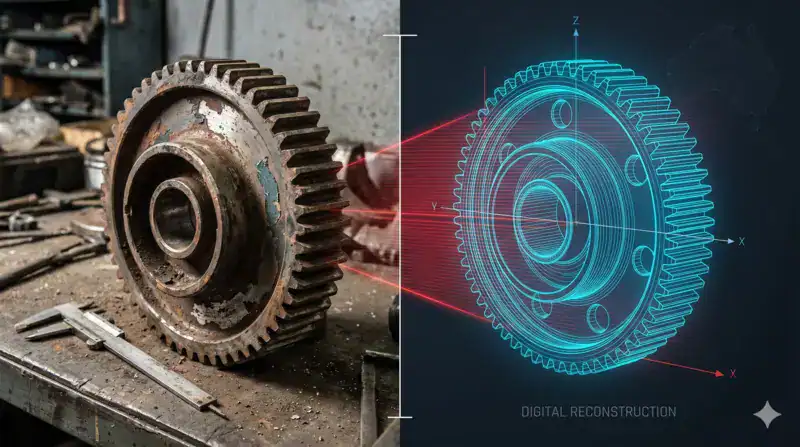
- High-Fidelity Scanning: A broken or worn part is scanned using lasers or structured light, capturing millions of data points to create a highly accurate digital “point cloud.”
- CAD Reconstruction: Using specialised software, our engineering team converts this point cloud into a clean, parametric 3D CAD model. During this phase, we don’t just copy the broken part—we correct the wear, fix the damage digitally, and optimise the design.
- Manufacturing-Ready Output: The finalised CAD file is then exported as a precise manufacturing blueprint. Whether the part needs to be CNC machined in steel, cast in aluminum, or 3D printed in advanced industrial polymers, the digital file is ready for production.
Real-World Applications Across Australia
At 3dmatic, we are seeing 3D scanning deployed across a massive variety of critical sectors:
- Mining & Earthmoving: Reverse engineering heavy-duty wear parts, pump housings, and custom tooling that endure extreme conditions.
- Agriculture: Digitising obsolete tractor components and custom harvester fittings to keep farms operational during peak harvest seasons.
- Automotive & Classic Restoration: Recreating discontinued engine components and custom bodywork for classic car restoration, where original parts simply do not exist.
Why Choose Our 3D Scanning Services Australia?
You don’t need an engineering firm right next door to solve complex mechanical problems. At 3dmatic, we provide comprehensive 3D scanning and CAD reverse engineering services to clients Australia-wide.
Whether you ship your damaged components directly to our facility for high-resolution scanning or you provide us with raw scan data to convert into manufacturing-ready CAD models, our team delivers the precision your industry demands.
Don’t let obsolete parts dictate your operational downtime. If you have a critical component that needs digitizing, upgrading, or reverse engineering, Contact the team at 3dmatic today for a technical consultation.overcome, more manufacturers are likely to use 3D printing for prototyping (and for manufacturing) during the product development cycle.
Frequently Asked Questions About 3D Scanning
Can you scan large-scale industrial equipment? Yes. Our metrology-grade scanners are portable, allowing us to capture highly accurate digital data from large machinery, heavy earthmoving equipment, and complex automotive chassis without dismantling the entire system.
How accurate are the final CAD models? We capture physical geometries with sub-millimetre precision. When we convert that point cloud into a parametric CAD file, we ensure the tolerances meet strict engineering standards, often resulting in a digital file that is more optimized than the original, worn-out part.
Do you manufacture the replacement parts as well? Absolutely. Once the digital reverse engineering is complete, the file is manufacturing-ready. We can output the file for CNC machining, casting, or utilise our in-house industrial 3D printing capabilities to produce the final physical component.